Da Couch Tomato

An attempt at a new layout, with horrible glitches, and very minimal knowledge of HTML.
Showing posts with label leonardo dicaprio. Show all posts


Da Couch Tomato Podcast Season 2 Episode 5, trying out the new format we call The Rundown. We do three short reviews in one episode! Sa episode na ito, ang aming pinag-usapan ay: 1) Don't Look Up (2021) ni Adam McKay, at ang parallelisms nito sa Philippine society, lalo na't napapalapit na ang eleksyon; 2) Old (2021) ni M. Knight Shyamalan, at kung gaano ka-fanboy si Sting Lacson ni Shyamalan despite The Last Airbender; at 3) Belfast (2021) ni Kenneth Branagh, at kung paano na-kwento ang isang mabigat na theme sa magaan na paraan.

Average ratings:
Don't Look Up: 7.4/10
Old: 7.45/10
Belfast: 7.4/10

"Let's try and do that dance John Travolta did in Pulp Fiction."

Once Upon a Time...in Hollywood is the ninth film from director Quentin Tarantino (Kill Bill Volumes 1 and 2 count as one film). He's famously quoted as dead set on doing only ten films during his career, so I guess that leaves just one more film left before he supposedly retires.

After watching this film, I've come to a not-so-shocking discovery: Quentin Tarantino is actually not the Hollywood wunderkind a lot of people think him to be.

That wasn't some haphazardly drawn conclusion as well. Tarantino displayed some directorial lapses in this film, lapses that may be forgiven for first-time directors, but not for someone who's on his ninth film. Actually, I counted only two lapses, but that's still two more than what should be expected of him. The two lapses I'm talking about involve a mismatched cut, and a horribly composed shot. There's also a minor lapse in the very first scene, but I'll let that slide because 1) it's more of having a feeling that something's off rather than being able to pinpoint what's off exactly; and 2) I watched this to be entertained, not to nitpick.

By the way, I'm not here to bash Quentin Tarantino's work. What he has going for him, definitely, is his original storytelling. Each and every single Tarantino-directed film is an original screenplay. He's never been lured by the chance to direct a superhero flick, or a film based on a book. Tarantino's films have their own cinematic universe, and I can think of no other filmmaker right now who never took off his auteur cap in his entire career.

"I would say Chris Nolan, but he doesn't really write his own stuff."

Moving on to the actual review, I'd like to start with the acting. This film has two great actors in the lead roles, thanks to Leonardo DiCaprio and Brad Pitt, who play the actor-stuntman tandem of Rick Dalton and Cliff Booth. Now the dynamics of that relationship is quite complicated: the actor of course is seen as higher than a stuntman in the Hollywood pecking order, and this is reflected in Cliff Booth's other job as Dalton's driver. I think DiCaprio and Pitt were able to pull it off, although there are instances where you see them as equals rather than the pseudo-employer-employee relationship the two of them should have. You with me so far? I told you it's quite complicated.

I have also come to realise that Tarantino's foot fetish is now officially creepy. I mean, I wouldn't mind close-ups of feet, as long as it propels the story forward. But to show feet close-ups just for the sake of showing them? No, thank you. He even gave Dakota Fanning's feet some considerable screen time, and I've also just realised that Dakota Fanning has hideous feet.

And finally, my main problem with Tarantino movies – and this is just me – is his use of alternate realities. Some people call this "revisionist fiction", but I'll just stick to calling it alternate realities. Tarantino did this before in Inglorious Basterds, where the Basterds ended up killing Adolf Hitler (which we all know didn't happen at all). In this film, the Tate murders never happened, and the Manson Family killers ended up dead at the hands of Dalton and Booth. What's my problem with alternate realities, you ask? I don't know how to properly explain it, but I am of the opinion that realities must be kept separate. Sure, there can be an infinite number of realities, each one different from the others, but they must never merge. Sure, you can travel between realities, from one reality to another, but they must never merge. Why? Because merging realities is the first step to insanity. And when one takes the first step of the journey to insanity, coherence and clarity are the first to go.

"How about an alternate reality where I do a Tony Montana as Michael Corleone?"


Once Upon a Time...in Hollywood. USA/UK/China. 2019.


Original rating: 7.6/10
Al Pacino: +0.1
Brad Pitt: +0.1
Not enough Margot Robbie: -0.1
Margaret Qualley's armpit hair: -0.2
Old school Columbia Pictures logo: +0.1
Luke Perry: +0.1
Terrible Bruce Lee portrayal: -0.1
Charles Manson being played by same actor who played Manson in Netflix's Mindhunter: +0.1
Tarantino's foot fetish: -0.1
Final rating: 7.8/10
I Am Your Target Demographic

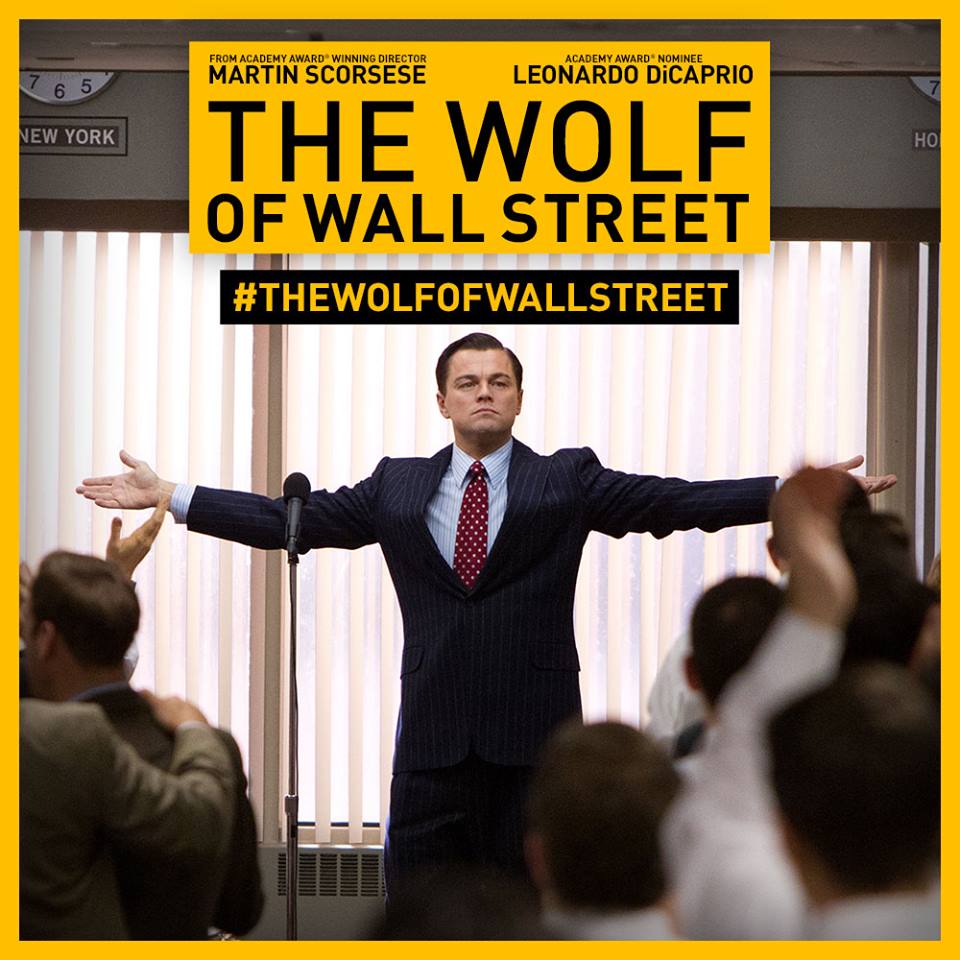
When asked to choose between Walking with Dinosaurs, 47 Ronin, and The Wolf of Wall Street, the answer was easy: the Scorsese film, of course. First, I didn't want to watch Ronin or Dinosaurs in 2D. Second, it's Scorsese.

It's most probably Scorsese if Leo DiCaprio is in it.

The Weinstein Company

*PISS OFF IF YOU HATE SPOILERS*

Whether you love Quentin Tarantino or you hate him, you can’t deny that he is one of the few living original storytellers for the cinematic medium. For that fact alone, Django Unchained stands apart from its Hollywood brethren of adaptations, remakes, and reboots.

The Weinstein Company
Also, Jamie Foxx in electric blue.

YouTube

First, the 3D review, just to get it out of the way.

Converted 3D has a totally different look compared to real 3D. Converted 3D is hyper-real, meaning it is even more 3D than actual 3D. With 3D conversion, you control the stereo depth─you can make characters pop out more if you want them to. And James Cameron knows this, because he knows stereography.

Sadly, they couldn't make Kate Winslet's nipples pop out more.

However, there is only so much 3D conversion can do. The original footage was never intended for 3D, which is why there are a lot of tracking shots and fast camera movements, things which stereographers generally avoid, as they spoil the 3D effect. Even the dissolves didn't feel like 3D dissolves, wherein you feel one layer of film atop the other. I think they converted the entire dissolve instead of converting the individual shots and dissolving both.

"Eh? You lost me at 3D."

Anyway, James Cameron tried his best.


Now we go to the regular review.

So, apart from the 3D, how is this re-release different from the Titanic movie of 1997 ('98 in the Philippines)? How is this different from the movie I cut classes for on the first day of its release? How is this different from the film I've seen thirteen times in the cinema and countless times on VHS?

As far as I know, nothing's changed, except for the stars. The story of Cameron's encounter with Neil deGrasse Tyson has already made its rounds on the Internet. So that's the only thing the director changed with his million-dollar baby. Pity he couldn't change that shot where Kate Winslet looked like a Michael V impersonation.

What changed, though, is your perception. You as a viewer back in '98 are no longer the same viewer that you are right now. Aside from aging physically, you've also aged emotionally. Now you can connect more with Billy Zane's emotions when he sees his fiancée falling head-over-heels in love with a poor boy. Now you can appreciate the injustice of class division (especially after watching Downton Abbey). Now you can feel more sentimental with the sinking ship montage.

This still remains my favorite shot in the entire film.

Now you can see that it's Theoden, King of Rohan who's captain of the Titanic. Now you can see that the kindest officer on the ship is Mr. Fantastic with an Irish accent.

Yes, that's Ioan Gruffudd. Just google how to
pronounce his first name.

Now you can realize that Kate Winslet does look fat in some shots. And now you can appreciate that Leonardo DiCaprio's acting skills have come a long way since the late 90s.

And now you can also realize that if he had his way, Cameron would never touch 3D conversion with a ten-foot pole. The only reason he re-released his Best Picture baby is because this April commemorates the 100th year since the sinking of this vessel. And he doesn't mind if he makes himself a couple million dollars in the process.

"King of the world, right?"


Titanic. USA. 2012/1997


Rating: Eight out of ten.

This is the film where I thought, "Wow, Leonardo DiCaprio has matured, finally."

And it's not because he speaks with a Rhodesian accent here. I haven't really heard authentic Rhodesian, so I wouldn't know. But you can sense Leo's dedication to the art of acting, and it shows in every movement of his body, every twitch of his muscles.

I think Orlando Bloom could've taken lessons from DiCaprio. Leonardo DiCaprio is living proof that great actors are made, not born.

Jennifer Connelly always looks good on camera. I've liked her since Labyrinth. And she ages with such grace, I envy Paul Bettany.

I like Djimon Hounsou when he acts normal. But when he starts shouting like a madman, like that "Give us us free" mode, he can sound pretty annoying. It's like a caged animal that will kill the first person it comes into contact with. Now isn't that frightening?


*some info from IMDb
pic from jasoncollin.org


Blood Diamond. USA/Germany. 2006 (2007 Philippines).


Rating: Six and a half out of ten.

It's a nice movie for two reasons: First, it's directed by Martin Scorsese. Second, it doesn't feel like it's directed by Martin Scorsese.

Now those two may seem contradictory at first, but they're not. Martin Scorsese is one of the most engaging directors in Hollywood today, and his films draw you deep into the world it creates. What you can expect from a Scorsese picture is clear storytelling, powerful performances, basic yet really effective camera work.

Now on to the second point. Scorsese's style is different in the sense that he has no style. Or it seems that he has none. That's because of his versatility. You cannot really definitely say that a film is Scorsese's based on the visuals or the narrative style. Scorsese can actually direct anything. I bet he could direct a romantic comedy if he wanted to. But I don't think he's into that sort of thing.

Anyway, probably the only indicator that this is a Martin Scorsese picture is Leonardo DiCaprio. I think DiCaprio is to Scorsese as Tom Hanks is to Steven Spielberg. Or maybe that's not such a good analogy. DiCaprio is like Scorsese's muse. But I don't think Hanks is Spielberg's muse. I'm not entirely sure, really.

Mark Ruffalo plays the sidekick so well that he doesn't even try be anything but a sidekick. He's a great team player, Ruffalo. Ben Kingsley, on the other hand, is subtly annoying. You'll hate him at first because of his villainous sneer. But then when he turns out to be not so bad after all, you'll realize that his sneer is actually an annoying smile. Brilliant.


*some info from IMDb
pic from movie-vault.com


Shutter Island. USA. 2010.


Rating: Seven point nine out of ten.
Number of times Scorsese's name is mentioned in this review: Ten.
By The Negation
Sat, 24 Jul 2010, 7:10


What can I say? I'm stumped! This flick is the shizzlenit! It's a thinkin' man's movie. If you're left with zero questions when this film ends, that doesn't mean that you are a movie expert. That means you can't understand shit because you can't comprehend a single thing that's happenin'!

Well anyway, I could go on forever explaining what the hell happened and everything. But I can't, because this film has a lot of intricate complexities. I admit that it's more complex than The Matrix. I could actually compare this to The Matrix (with the Architect and other stuff like that). I could say that "Inception is the new Matrix". Without the "Geta-Zone" shots of course. But still, Inception's effects were eye candy to say the least.

Christopher Nolan is a thinkin' man's director. He made my mind work in The Prestige and The Dark Knight (hence, the familiar Batman Begins/Dark Knight faces in Inception like Cillian ["Kill-Yan"] Murphy and Michael Cain), but I didn't really expect him to make my mind work this much in this movie. Damn Inception! I'm still hung-over. This rant was due a week ago, but I'm just waiting to exhale after the movie. In fact, I will watch this again this coming Sunday! But first, I must watch The Sorcerer's Apprentice and The Last Airbender. Fuck Salt for now.

All I can say is that I give this movie a perfect 10 out of 10 due to the fact that it was all Nolan. Well DiCaprio was pretty impressive too. I haven't watched Blood Diamond yet but my couch tomato bro told me that Leo's acting chops started to sharpen up in this movie. I hope Orlando Bloom's acting goes the same direction as Leonardo's.

Another thing, I'm Asian. And so is Ken Watanabe. 'Nuff said!


(More reviews on Inception after the jump.)

If telling a Body of Lies doesn't hunt your conscience, then maybe you're fit to be a spy. It's Leonardo DiCaprio, so what the heck. Hehe.

The film follows the story of a CIA operative Roger Farris (Dicaprio), the man on the ground, and Ed Hoffman (Russell Crowe), the man with the phone and satellite what-have-yous, tracking down a terrorist. The story reveals the amount of deceit and secrecy—either with decorated officials or with people who are easily dispensable—involved in these kinds of operations. They do everything to get vital intel and thus get the bad guy. But in this world of espionage, you don't really know who your enemies or your friends are.

Roger Farris is the heart of the movie, and I must admit, Leo has grown as an actor from his portrayal of Romeo in the modern adaptation of Shakespeare's Romeo and Juliet. Ed Hoffman is just plain cold, though he appeared to want to protect his colleague (Crowe, by the way, is a good actor, but not so much of a hunk here. Boo.). And this precise difference in personalities works for the film. Throw in the Jordanian Intelligence head and the terrorist in the mix, and you've got four different minds set to doing what they feel is the right way (or the only way) to do things.

Overall I'd say it's just another spy movie, but with DiCaprio and Crowe in the mix, it's definitely something to watch. I can't say it'll alter someone's take on espionage, though, or the way Americans deal with terrorists or international relations. As Ed said, "No one's innocent in this shit." Indeed, no one is. But how well do you sleep at night?


Body Of Lies gets six out of ten, for spy agents DiCaprio and Crowe really, and for Uncle Sam’s faulty ways.


*photo from allmoviephoto.com

In 2007, Director Martin Scorsese finally won an Oscar for Best Director for his cops and robbers drama, The Departed. The movie, a remake of an acclaimed 2002 Hong Kong film Mou Gaan Dou, more popularly known as Infernal Affairs, had an amazing cast with the likes of Jack Nicholson, Matt Damon, Leonardo DiCaprio in the lead as well as Alec Baldwin, Martin Sheen and Mark Wahlberg playing secondary characters. On the other hand, the original also had heavyweights with the likes of Andy Lau (House of Flying Daggers), Tony Leung (Hero, Lust Caution), Anthony Wong (The Mummy: Tomb of the Dragon Emperor) and Eric Tsang in the lead. While the names are not that familiar to some, they represent the cream of the crop in Hong Kong Cinema.


The cast comparisons, as far as the major roles are concerned, are as follows, and I’ll just use the US version’s character names as reference:

Leonardo DiCaprio and Tony Leung as Billy Costigan
Matt Damon and Andy Lau as Colin
Martin Sheen and Anthony Wong as Queenan
Jack Nicholson and Eric Tsang as Costello

William Monahan adapted the screenplay written by Siu Fai Mak for the American audience and used Boston and the local underground world as the backdrop for the events.

Even before it came out, comparisons between the two movies swirled. While remakes will always be compared to the original, especially in the case of American remakes, the level of awareness in this case is heightened by the fact that it was being done by no less than the great Martin Scorsese with his aforementioned killer cast. This isn’t Gore Verbinski remaking The Ring. This is Martin Scorsese, the master, the man.

So did Scorsese deliver? Is the Original better?

The story as we all know by now involves two moles, Billy and Colin, one for the police and one for the mob. A series of events leads them to realize that there is a mole in their respective group and they try to smoke each other out.

Acting-wise, the two movies are at a stalemate. I will always see this movie as the first part of Leonardo DiCaprio’s transformation into a man, the second part being Blood Diamond which came out later that year. While DiCaprio always plays the trapped, tortured soul extremely well even in his earlier films like The Basketball Diaries and Catch Me If You Can, in this film, it seems that he reached a whole level of repressed anger which could only be achieved through age. Tony Leung always seems to be in a serene state which makes his break down all the more effective. The role is actually perfect for him. Unlike DiCaprio whose undercover cop is a raging bad boy who will fight anybody, Leung goes the other way as he pretends to not to give a shit about the mob and its operations at all. Surprisingly, both are effective and both fit in with the role and the movie.

Andy Lau and Matt Damon on the other hand play the role practically the same way. Their image in the police force is that of a young achiever, on his way to the top. Both exude what can only be described as being a gentleman asshole who are at the top of their game both as a policeman and a mobster. Damon and Lau are at a point in their careers when they are so likeable that you forget that they are playing the role of the bad guy in the movie which ultimately makes you on the same level as the police force they are deceiving.

Sheen and Wong, veterans that they are, understand that their role is not very showy but equally important. Their role is as close to a father figure for Billy as he can get and in a society of faulted figureheads, this is important. The difference is actually not a way of acting but a person and that person is Dignam played by Mark Wahlberg. While DiCaprio’s character had two links to the force, Leung’s only had one. This subtle difference changes a lot of the dynamics in the story and essentially, at least for this writer, creates the difference between the two films.

In the beginning of Infernal Affairs, there was a short premise about the so-called Continuous Hell which was the worst of all hells because of the continuous suffering that one would experience in it. This is what their characters basically experience in IA. Leung never liked being an undercover and he’s been at it for more than nine years and he feels like he’s just about to lose it. He desperately wants to be a cop, an ordinary one, but for now the only police thing that he can do is to salute as a funeral car of a dead cop passes by. On the other hand, Lau’s Colin is a guy who does not really want to be a crook from the very beginning. He was thrust in this role as a young man and he cannot get out of it. Thus they live in their own personal continuous hell. They live a life that they do not want and they see no end to it.

In The Departed such struggle is not quite as clear-cut. Damon’s Colin does not seem to have a problem with being a mole. There is no moral struggle, at least visibly, in him and in a way, he seems to get worse and worse. DiCaprio’s Billy is more faithful to Leung’s however. Just like Leung, he wants to get out of the game although his desperation seems to stem more from his fear of getting caught by Costello than by being in the undercover business for a long time. There lies another difference between IA and TD. Leung has been undercover for ten years while DiCaprio could not have been more than three. The desperation is present in both but less palpable in The Departed.

Which brings us back to the celebrated role of Dignam. In IA, there is no Dignam but rather the role is spread out in different characters. The first “Dignam” who along with Inspector Wong knew about Leung’s undercover role was in the movie but was killed prior to the main events. This was seen in IA II. Other Dignam scenes were present as well but they were passed on to other roles such as the OCB head which in TD was played by Alec Baldwin. The importance of Dignam in changing the storyline can mostly be seen after Sheen’s character died. Billy Costigan was desperate but Dignam could be somewhere and he could meet up with him somehow. Leung's character on the other hand was totally fucked the moment Inspector Wong died. Logically speaking, Billy could still have things fixed up as soon as Dignam shows up and so he did not have to deal with Colin. Leung had nowhere to go and so his desperate fateful act was entirely logical.

In almost every story there is a battle between good and evil. As we all know, the Good almost always wins and in IA such holds true. While Lau’s character survives, good still won over evil because evil, Lau’s character, became good in the end as when he betrayed Sam and gave the appropriate recommendation for Leung's character. In TD, Colin only turned against Costello because he was afraid that Costello was going to turn him over to the FBI being that Costello was an informant of crooked FBI agents. It was not a triumph over evil. It was a necessity more than anything.

Infernal Affairs is an awesome film and Infernal Affairs II the prequel, only strengthened its power. The only problem with the franchise is that it was ruined by Infernal Affairs III and if one can stay away from this horrible sequel please do so.

The Departed won Best Picture despite the fact that it was not even in the Top Five of Scorsese’s movies. It won an award for Best Editing even though it was probably Schoonmaker’s worst work ever and is absolutely on the other end of the spectrum compared to GoodFellas. The lack of continuity in the shots is distracting at times because of the lack of smoothness in the transition. Some key points were also unbelievable like the scene where Billy’s message alert tone went off when only a minute ago he’s been receiving text messages on silent mode.

Finally, The Departed was indeed a good movie and could have been deserving of an Oscar for Best Picture and Best Director. Sadly, it seems more of a charity case for Scorsese for having lost so many times while deserving a win at the same time. Personally I feel uncomfortable when someone, especially a great one like Scorsese, wins an award for a remake. That’s like winning Best Vocal Performance for a cover version of a popular song. In the end, Scorsese should have won many times over and it is a tragedy that he has to win for this one.


Infernal Affairs: 9/10
The Departed: 9/10
At Gunpoint: Infernal Affairs

Premium Blogspot Templates
Copyright © 2012 Da Couch Tomato