DCT Podcast
DCT Season 2 Episode 25: Im Westen nichts Neues / All Quiet on the Western Front (2022), or Probably the Dirtiest World War I Film to Date
DCT Podcast
DCT Season 2 Episode 24: Avatar: The Way of Water IMAX 3D (2022), or Why Does James Cameron Love the Water so Much?
DCT Podcast
DCT Season 2 Episode 23: Strange World (2022) 3D, or Disney Gets Woke
DCT Podcast
DCT Season 2 Episode 22: Black Panther: Wakanda Forever (2022), or Rest in Power, Mr. Chadwick Boseman
DCT Podcast
DCT Season 2 Episode 26: The Rundown: The Banshees of Inisherin (2022), The Fabelmans (2022), and Elvis (2022)
Showing posts with label science fiction. Show all posts
[NOTE: The original review was written by Sting Lacson. Siege Malvar remixed it as an attempt to create a dialogue of reviews, in blog form.]
STING: Super 8 is the new Goonies. And it's not just because of the kids. The entire movie has the same Goonies feel. The entire film is actually an homage to Steven Spielberg's eighties flicks, specifically Close Encounters of the Third Kind and The Goonies.
When I saw this, I had no idea what it was about. Well, I had some idea.
SIEGE: Super 8 is the new Goonies, and the new Lost.. And the new E.T. And the new Jaws. When I heard Spielberg is doing a movie with J.J. Abrams, I expected nothing less. Predictably, the movie reeks of the two auteurs' influence and style. Which is not necessarily a bad thing.
Super 8 feels like a signature film born of the two powerful storytellers that are Spielberg and Abrams. A collaborative dialogue that is indistinguishably neither Spielberg nor Abrams, but, like a mestizo Pinoy Big Brother hopeful from Olongapo, a beautiful bastard of both.
1. It was directed by J. J. Abrams.
STING: Not just directed. Written and directed. I've never seen an episode of Fringe. But I have seen Star Trek, and I liked it. But after watching Super 8, Abrams now joins my list of "Directors I Would Watch With No Questions Asked". Yes, Abrams might be guilty of excessive use of lens flares, but you'll get used to it. It doesn't diminish the beauty of his images in any way. Just try to think of it as Abram's own personal watermark. Lens flares are his signature move, anyway.
SIEGE: I, on the other lensflared hand, am a big fan of Abrams LOST, and could definitely parse out the movie in various J. J. Abrams trophes:
2. There was a train crash.
STING: Yes, the train crash was the sort of centerpiece of the story. Everything revolved around it. The explosions might have been a bit excessive. But then again, I've never seen a train crash in my life.
SIEGE: J.J. Abrams is a big fan of EXPLOSIONS. As evident in the opening sequence of Lost (see here), and this M:I:3 sequence (see here). And as you can see, Abrams uses his explosions to propel the drama forward. More than spectacles of firepower, Abrams uses big bangs as opportunities to test his characters: What would you do when the train/plane/bridge you're on explodes?
STING: And these were the things I did not know about:
1. It had a love story.
STING: Yes, that's right. A love story. One that had me giggling like a schoolboy. Elle Fanning is pretty. And for the record, she looks nothing like her sister Dakota.
SIEGE: It doesn't simply have a love story; it is the story about love: how the boy grieves for the mother he has lost, and what letting go means. It's about a father's love for his child (son and daughter). There is that romantic triangulation between the three kids, true. Still another Abrams trademark.
2. It was produced by Steven Spielberg.
STING: And I'm not sure if the Goonies tribute was an ass-kissing move by Abrams as a thank-you to Spielberg for producing this film. But I think Steven's hand in the production is a sign that this guy Abrams is a great storyteller. Oh, wait. Spielberg also produced all the Transformers flicks. And I don't think it's because he thinks Michael Bay is a great storyteller.
SIEGE: Yes, Spielberg's influence is strong on this one. The theme, the treatment. The director's trademark of tiny simultaneous details happening. The parent-child dramatic tension. The low height tracking shot. You know how Jaws scares you with the scoring even before you see the actual shark? They did the same thing with the Monster here.
3. This is the best movie I've seen this year. So far.
STING: I pride myself in having good cinematic taste, and I can say with conviction that Super 8 is one of the best original movies to come out of 2011. But the year isn't over yet, so we shall have to wait and find out. And maybe, if it weren't too sci-fi and alien-y, this should get a nod for a Best Picture Academy Award.
SIEGE: The amazing thing about this movie is its heart. It's a big, bad-ass movie about a giant monster from outer space, but it's not about that. It's about ordinary people in extraordinary circumstances, and how the human spirit would persevere in those situations.
As supplementary viewing, I'm requiring you guys to watch this TED TALK by J. J. Abrams where he talks about "investment in character".
Super 8. USA. 2011.
STING'S VERDICT:
Rating: Eight and a half out of ten.
Feeling like a schoolboy with a crush: Eight out of ten.
SIEGE'S VERDICT:
Rating: Eight and a half out of ten.
Feeling like a fanboy watching his two idols having a dialogue: Ten out of Ten.
You may also want to read the Super 8 review by Sting Lacson.
STING: Super 8 is the new Goonies. And it's not just because of the kids. The entire movie has the same Goonies feel. The entire film is actually an homage to Steven Spielberg's eighties flicks, specifically Close Encounters of the Third Kind and The Goonies.
![]() |
| That yellow jacket on the fat guy is definitely a Goonies nod. |
When I saw this, I had no idea what it was about. Well, I had some idea.
SIEGE: Super 8 is the new Goonies, and the new Lost.. And the new E.T. And the new Jaws. When I heard Spielberg is doing a movie with J.J. Abrams, I expected nothing less. Predictably, the movie reeks of the two auteurs' influence and style. Which is not necessarily a bad thing.
Super 8 feels like a signature film born of the two powerful storytellers that are Spielberg and Abrams. A collaborative dialogue that is indistinguishably neither Spielberg nor Abrams, but, like a mestizo Pinoy Big Brother hopeful from Olongapo, a beautiful bastard of both.
1. It was directed by J. J. Abrams.
STING: Not just directed. Written and directed. I've never seen an episode of Fringe. But I have seen Star Trek, and I liked it. But after watching Super 8, Abrams now joins my list of "Directors I Would Watch With No Questions Asked". Yes, Abrams might be guilty of excessive use of lens flares, but you'll get used to it. It doesn't diminish the beauty of his images in any way. Just try to think of it as Abram's own personal watermark. Lens flares are his signature move, anyway.
![]() |
| "Problem?" |
SIEGE: I, on the other lensflared hand, am a big fan of Abrams LOST, and could definitely parse out the movie in various J. J. Abrams trophes:
- Blonde dude v. Dark haired dude. Totally Sawyer v. Jack, all throughout the movie.
- The Monster Reveal. Abrams used the same cocktease technique in developing Smokey from Lost, and that giant alien from Cloverfield. It's like that Five Blind Pilgrim tale. We get parts and pieces of the monster, we hear it coming, we hear it groaning (in anger? in pain?), we see an arm grabbing one of the characters and shaking him all over the place like a rag doll. The intent is to create a horrible monster in our head in the spaces formed between the parts and pieces: Is it a giant bug? Is it Cthulhu? Is it reptilian or robotic? We create the monster we're most afraid of, and that's what makes Abrams's brand of horror effective.
- Composite Technology. Whereas Lost's Smokey is dark flecks of matter (that can either be self-aware nanobots or a swarm of possessed black bugs native to The Island), Super 8's Monster uses a similar composite technology that plays a pivotal point in the plot.
- Scoring. Definitely a director's trademark here. Every highlight of the movie is punctuated by Michael Giacchino.
- MUCH more. If you're a dedicated Lostie, you'll definitely want to watch this one. It's like Abrams is doing fan service.
2. There was a train crash.
STING: Yes, the train crash was the sort of centerpiece of the story. Everything revolved around it. The explosions might have been a bit excessive. But then again, I've never seen a train crash in my life.
SIEGE: J.J. Abrams is a big fan of EXPLOSIONS. As evident in the opening sequence of Lost (see here), and this M:I:3 sequence (see here). And as you can see, Abrams uses his explosions to propel the drama forward. More than spectacles of firepower, Abrams uses big bangs as opportunities to test his characters: What would you do when the train/plane/bridge you're on explodes?
STING: And these were the things I did not know about:
1. It had a love story.
STING: Yes, that's right. A love story. One that had me giggling like a schoolboy. Elle Fanning is pretty. And for the record, she looks nothing like her sister Dakota.
![]() |
| I still don't know who's prettier, though. |
SIEGE: It doesn't simply have a love story; it is the story about love: how the boy grieves for the mother he has lost, and what letting go means. It's about a father's love for his child (son and daughter). There is that romantic triangulation between the three kids, true. Still another Abrams trademark.
2. It was produced by Steven Spielberg.
STING: And I'm not sure if the Goonies tribute was an ass-kissing move by Abrams as a thank-you to Spielberg for producing this film. But I think Steven's hand in the production is a sign that this guy Abrams is a great storyteller. Oh, wait. Spielberg also produced all the Transformers flicks. And I don't think it's because he thinks Michael Bay is a great storyteller.
![]() |
| "My multi-million dollar bank account says otherwise." |
SIEGE: Yes, Spielberg's influence is strong on this one. The theme, the treatment. The director's trademark of tiny simultaneous details happening. The parent-child dramatic tension. The low height tracking shot. You know how Jaws scares you with the scoring even before you see the actual shark? They did the same thing with the Monster here.
3. This is the best movie I've seen this year. So far.
STING: I pride myself in having good cinematic taste, and I can say with conviction that Super 8 is one of the best original movies to come out of 2011. But the year isn't over yet, so we shall have to wait and find out. And maybe, if it weren't too sci-fi and alien-y, this should get a nod for a Best Picture Academy Award.
SIEGE: The amazing thing about this movie is its heart. It's a big, bad-ass movie about a giant monster from outer space, but it's not about that. It's about ordinary people in extraordinary circumstances, and how the human spirit would persevere in those situations.
As supplementary viewing, I'm requiring you guys to watch this TED TALK by J. J. Abrams where he talks about "investment in character".
Super 8. USA. 2011.
STING'S VERDICT:
Rating: Eight and a half out of ten.
Feeling like a schoolboy with a crush: Eight out of ten.
SIEGE'S VERDICT:
Rating: Eight and a half out of ten.
Feeling like a fanboy watching his two idols having a dialogue: Ten out of Ten.
You may also want to read the Super 8 review by Sting Lacson.

Have you ever seen something promising go down faster than you can say "crap"?
Virtuality starts off with a great idea for a TV series: A TV series about a reality show that documents a starship voyage to find habitable land in a star system near the Milky Way.
The crew is composed of engineers, doctors, physicists and botanists who are given Virtual Reality modules to keep them sane. Unfortunately, a virtual man starts harming them in their fantasies.
For some reason, this virtual man's violent acts cause the crew to push through with the voyage despite the fact that their only doctor discovers he has Parkinson's disease.
This is where the whole thing goes awry.
Some of the crew take to finding out who the virtual man is and killing him; which they aren't able to. Others abandon it and simply take it as a sign to "live."
They had to turn this TV pilot into a two-hour movie without closing it off properly. An accident causes the captain's death. The crew's designer and engineer makes a confession to someone on earth that he thinks the captain was murdered. The second mate is reluctant to be the new captain. And the psychologist/reality show producer discovers soon after the death that the captain was having an affair with his wife. So who then, killed the captain?
Is the capatin even really dead? Because the way the "movie" ends, it doesn't seem that way. It's like the writers were hoping they'd get a sequel or an actual TV series. Well, it actually looks like they do. But with a movie, you still need some closure of sorts.
So, because it's only this movie's first half that's good, I'm giving this 5/10. Too bad for Clea DuVall.
Virtuality starts off with a great idea for a TV series: A TV series about a reality show that documents a starship voyage to find habitable land in a star system near the Milky Way.
The crew is composed of engineers, doctors, physicists and botanists who are given Virtual Reality modules to keep them sane. Unfortunately, a virtual man starts harming them in their fantasies.
For some reason, this virtual man's violent acts cause the crew to push through with the voyage despite the fact that their only doctor discovers he has Parkinson's disease.
This is where the whole thing goes awry.
Some of the crew take to finding out who the virtual man is and killing him; which they aren't able to. Others abandon it and simply take it as a sign to "live."
They had to turn this TV pilot into a two-hour movie without closing it off properly. An accident causes the captain's death. The crew's designer and engineer makes a confession to someone on earth that he thinks the captain was murdered. The second mate is reluctant to be the new captain. And the psychologist/reality show producer discovers soon after the death that the captain was having an affair with his wife. So who then, killed the captain?
Is the capatin even really dead? Because the way the "movie" ends, it doesn't seem that way. It's like the writers were hoping they'd get a sequel or an actual TV series. Well, it actually looks like they do. But with a movie, you still need some closure of sorts.
So, because it's only this movie's first half that's good, I'm giving this 5/10. Too bad for Clea DuVall.
By Sting Lacson
17 May 2010, 10:04.
17 May 2010, 10:04.
Because I liked the film, I must write about it. Such is my curse.
I was never a Star Trek fan, but I've seen one of the old Shatner episodes on TV, and I'd like to check it out.
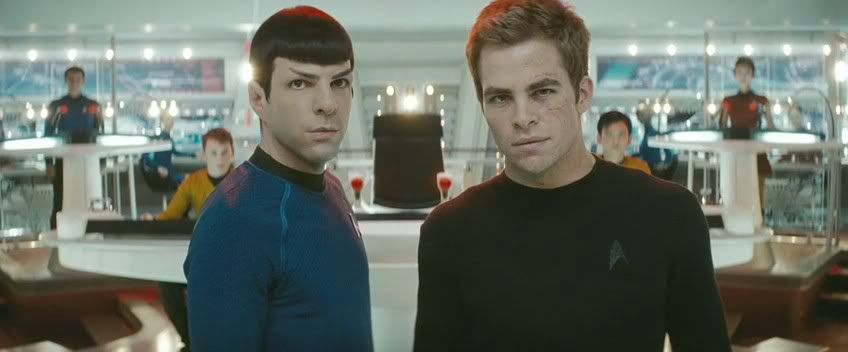
J.J. Abrams rocks. And so does Chris Pine. James Tiberius Kirk. I just love the way that name rolls off the tongue. James Tiberius Kirk. Eric Bana is unrecognizable. Simon Pegg is the comic relief.
I expected this film to suck. I was wrong. And I love it when I'm wrong. About movies, that is.
And finally, a new Hollywood doctrine has been established: Sequels are dead. Prequels are the new sequels.
*some info from IMDb
pic from photobucket.com
Star Trek. USA. 2009.
Rating: Eight and a half out of ten.
(Read more on Star Trek after the jump.)
It's only been a few hours since I've seen the original 1951 version of The Day the Earth Stood Still. Like a lot of people who have seen the remake, I thought the new film was okay with the regular amount of plot holes and exaggerations that always seem to hound Hollywood movies. I read some articles on the new movie and how they were disappointed with this version and how they longed for the older version. As it was, I watched the original version expecting a much better film than Keanu's version or at least a better movie overall.So was it?
In a word, no.
Unlike a lot of movie fanatics, I am not swayed by the idea that the older version always trumps the new one. I do not care about thinking that the original had a lot better plot or had better actors or that they had to make do with what they have back in the day. To put it bluntly, The Day the Earth Stood Still (1951) is a disappointment.
The two versions are actually two very different movies. The only thing that they truly shared are the title, character names, the idea of destroying mankind and the anti-climactic ending (the 1951 version trumping the new one on this aspect).
The plot line of the original version is this: aliens arrive on Earth because of a couple of recent developments---Man's discovery of Atomic Energy (this is 1951 after all) and Man's recent fascination with rockets and going to space. The two combined is what troubles these aliens. They do not care about the planet and unlike the new film, talk about Earth only as a whole and almost never as Earth and Mankind. They fear that soon, Earth would be arming these rockets with atomic warheads and begin destroying other planets.
And so they bring in Klaatu, played by Michael Rennie, a rather less stoic or more human version of Keanu Reeves. The purpose, supposedly was that to tell the world leaders of this problem and that the world as a whole should accept their proposal or risk annihilation.
This is where the plot bogs down and yet gets glazed over by every single film critic I've read. The proposal is essentially to stop this scientific development because they would be considered as a threat to the peace and stability of the universe. In a modern day analogy, this is the same as when the US does not want other countries to develop nuclear weapons because they threaten the peace and stability of the world as a whole. While the idea may be good, it does not alter the fact that in both cases, the people (or aliens) ordering this shutdown in development have the exact same capability as that which they do not want others to have.
The hypocrisy of this alien is therefore omnipresent as they do not want us to develop these capabilities (which we are nowhere near having especially at that time) because we "might" destroy other civilizations (that we do not even know exists) or else we ourselves, the entire Earth, will be destroyed.
In a sense, the new version is even a plot upgrade from the old one as at least the new one makes more sense. In the new version, we are asked to reform our ways because we are destroying our planet and I suppose, these Aliens are life protectors or something. I personally do not like the moral posturing of the new version. While I like the idea that we should change our ways, I do not understand why the Aliens seem to care about what we do. It would have been a much better idea if the Aliens wanted to annihilate mankind because we are destroying our planet and that if we do succeed in killing Earth, it would cause some cosmic catastrophe of some sort (like a black hole) which would disrupt life on their planet. That would have been less preachy.
Back to the 1951 version, Klaatu just wants to talk to the people and say these things and in a sense, he was able to do so in the end. However, there is nothing that would show any resolution to the story. No, it's not not the kind of lack of resolution that makes you think "Hmm... what could possibly happen?" It's the kind of lack of resolution, that makes you think "WTF?"
The musical score of this 1951 movie is top notch from start to finish. They always put you in the right mood that seems to warn you of an impending doom which eventually never happens.
A lot of people think that Keanu's The Day The Earth Stood Still is a bad remake of an awesome film. In truth, 2008 is an okay version of a slightly below average 1951 version.
The Day The Earth Stood Still (1951): Three Stars.
The Day the Earth Stood Still (2008): Three Stars.
At Gunpoint: 2008 over 1951.
I saw this film after the nauseating camera movement of Quarantine, and I thought to myself, "Finally, a proper movie."But that's all this is---a proper movie. Not even a great movie. Just proper.
First of all, it's a sci-fi flick. Very few science fiction movies can come up with something original this day and age. Aliens and spaceships and aliens and saving the earth and more aliens---this is basically what this film is in a nutshell. Well, this actually is a remake of a 1951 film of the same title, directed by Robert Wise (who directed The Sound of Music). This 2008 version was directed by Scott Derrickson, and what he did was to update some themes in the old version to make it more relevant to today's audience.
Okay, let me stop pretending I know a lot about the original 1951 version, so for a comparative analysis between the two films, just read this excellent review.
Let's just go directly to the aspect that I love to criticize the most: acting. First of all, Keanu Reeves. It might be just me, but I really think that Keanu Reeves has a very limited acting style. I know he tries hard, God bless him, but somehow it seems his best performance was playing Ted "Theodore" Logan of the Bill and Ted films. Now Jennifer Connelly is another story. I've loved her since Labyrinth, and her Oscar win for A Beautiful Mind cemented her status as a really talented actress. I think it's in her eyes, which does half of her acting for her.
Another Oscar winner in this film is the wonderful Kathy Bates, but I believe her role in this film as the US Secretary of Defense downplays her acting abilities. Veteran John Cleese makes a very short appearance as some Nobel Prize-winning scientist, while Jaden Smith (son of Will Smith and Jada Pinkett) gives an annoyingly good performance. His acting is so effective that you'd hate the brat.
Anyway, before the holiday lineup invades the movie theaters, go see this movie if you love effects-driven films, or if you want to see Keanu Reeves's handsome mug on the big screen. But for the true science fiction fans, the only thing worth waiting for right now would be the remake of Frank Herbert's Dune.
Rating: Three and a half stars.
Subscribe to:
Posts
(
Atom
)